What is the Definition of Implied Powers?
Implied powers are powers assumed by the United States government that are not explicitly stated in the Constitution.
Congress, Implied Powers, and Article 1 of the Constitution
Congress can exercise powers not explicitly expressed in the Constitution but considered “necessary and proper” to carry out its specified powers.
Article I, Section 8 of the Constitution contains the Necessary and Proper Clause, commonly referred to as the “elastic clause,” which is the basis for implied powers. It specifies that Congress can make “all Laws which shall be necessary and proper” to carry out its stated or enumerated powers.
In other words, this power enables Congress to govern the nation as it evolves effectively.
The Early Republic and Implied Powers
In the early days of the Republic, implied powers became relevant for whether the federal government had the power to create a national bank. In 1791, Congress created the First Bank of the United States based on its implied powers. Alexander Hamilton defended the bank’s creation by arguing that Congress had implied authority under the Necessary and Proper Clause to fulfill its enumerated powers, such as collecting taxes and regulating commerce.
In 1819, the Supreme Court confirmed this Congressional power in a decision known as McCulloch vs. Maryland. This John Marshall court case is a prime example of defending Congress’s implied power because it does not directly state in the Constitution that the government has the authority to create a bank.
Expressed Powers Are Different
While implied powers refer to those powers that are more interpretative, expressed powers are directly given to the government. They are also stated in the Constitution.
Traditionally, they are listed as 18 distinct clauses, though some group them differently. They are also referred to as delegated or enumerated powers.
For example, Congress has the express power to collect taxes and regulate commerce. Congress is directly empowered to coin money and declare war, as specified in Article I, Section 8.
Examples of Implied Powers
From the early Republic to the present day, Congress has relied on implied powers to carry out its work. These powers are not listed directly in the Constitution but are justified as necessary to enforce expressed powers such as collecting taxes, regulating commerce, and raising armies. Key examples include:
Creating the First Bank of the United States (1791)
Defended by Alexander Hamilton as necessary for collecting taxes and regulating commerce.
Later upheld by the Supreme Court in McCulloch v. Maryland (1819).
Establishing the Internal Revenue Service (IRS)
Based on Congress’s power to collect taxes.
Passing minimum wage laws
Justified under Congress’s power to regulate commerce.
Regulating firearms
Starting with the National Firearms Act of 1934, Congress used its commerce power to regulate interstate trade in firearms.
This remains a debated area, especially in connection with the Second Amendment.
Creating a military draft (conscription)
Not directly mentioned in the Constitution, but tied to Congress’s authority to raise and support armies.
Establishing a national healthcare system (Affordable Care Act, 2010)
Defended as necessary to promote the general welfare and regulate interstate commerce.
Building and maintaining infrastructure (roads, bridges, canals, interstate highways)
Not listed explicitly, but carried out under the commerce clause and the power to provide for the general welfare.
Creating federal agencies such as the Federal Communications Commission (FCC), the Environmental Protection Agency (EPA), and the Federal Reserve.
These agencies exercise powers not spelled out in the Constitution but are tied to regulating commerce, protecting the environment, or managing the economy.
Together, these examples show how implied powers expand the ability of Congress to respond to new issues as the nation grows and changes.
Are Implied Powers Good for the Nation?
Implied powers are open to interpretation, so people see them as both good and bad for the nation. Some may consider the expansion of federal power a positive trend, while others would not.
For example, much debate today surrounds the Second Amendment right to bear arms. Some would argue that the government’s implied power to regulate firearms is beneficial to the nation. Others would argue that it is an infringement of civil liberties.
Another key area of a long-standing debate over implied powers relates to the Tenth Amendment. This is the last amendment of the Bill of Rights and states that “powers not delegated to the United States by the Constitution, nor prohibited by it to the States, are reserved to the States respectively, or to the people.” This means that someone may construe the expansion of implied powers as infringing upon state or individual rights.
Does the President Have Any Implied Powers?
Yes, the president also has implied powers. A prime example would be the power to make executive agreements. These are similar to formal treaties with other nations but do not require Senate approval.
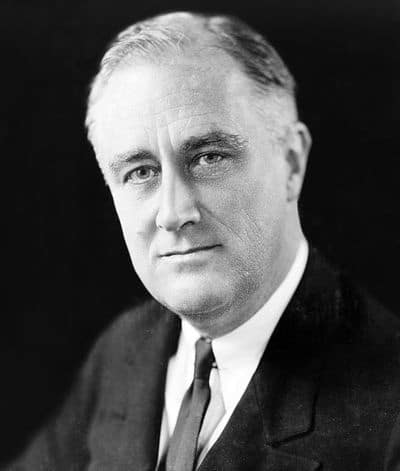
The president can shape foreign policy through implied powers. This may mean a change in approach, such as the policy of containment during the Cold War. The president can also issue executive orders based on implied powers. For example, Franklin Roosevelt issued Executive Order 9066 during World War II to establish Japanese American Internment camps.
Examples of Presidential Implied Powers
Like Congress, the president also exercises powers that are not explicitly stated in the Constitution. These powers are often tied to the president’s role as commander in chief and chief diplomat. Key examples include:

Get Smarter on US News, History, and the Constitution
Making executive agreements
Informal agreements with other nations do not require Senate approval, unlike treaties.
Issuing executive orders
Directives that manage operations of the federal government.
Example: Franklin Roosevelt’s Executive Order 9066 during World War II, which established Japanese American internment camps.
Directing foreign policy
Example: The policy of containment during the Cold War was not spelled out in the Constitution but shaped by presidential leadership.
Acting as commander-in-chief during wartime
Presidents have sent U.S. troops into conflicts (Korea, Vietnam, Iraq, Afghanistan) without a formal declaration of war from Congress.
Claiming executive privilege
Withholding information from Congress or the courts to protect confidential communications.
Not in the Constitution, but asserted by many presidents.
Issuing pardons and reprieves in broad ways
While the Constitution mentions pardons, presidents have used this power expansively, such as mass pardons for draft evaders after Vietnam.
Managing national emergencies
Using implied authority to impose measures during crises, such as seizing industries, restricting trade, or expanding surveillance.
These examples show that presidential implied powers, like those of Congress, have expanded over time, often sparking debate over the limits of executive authority.
Implied Powers, Federalism, and the Federal Government
The United States was established under a federalist model of government. This means that power is distributed and shared from the federal to state levels. Implied powers run right into the balance and debate over power between the national and state governments.
Interpretations of Article 1 of the Constitution have tended to confirm federal authority based on implied powers. For instance, interpretations of implied powers related to the commerce clause reinforced Congress’s authority. In the 1824 United States Supreme Court case Gibbons vs. Ogden, the ruling affirmed Congress’s authority over the states of New York and New Jersey based on its power to regulate interstate commerce.
Debates and discussions will surely continue over federalism, but historically, Congress has tended to gain more power through implied powers.
Overview of Implied Powers and Their Role in Government:
| Aspect | Summary |
|---|---|
| Definition | Implied powers are powers exercised by the government that are not explicitly granted to it by the Constitution, but are implied or inferred from the language or purpose of the Constitution. |
| Origin | Chief Justice John Marshall established the constitutional legitimacy of implied powers in the landmark Supreme Court case McCulloch v. Maryland (1819). |
| Examples | Examples of implied powers include the power to create a national bank, the power to regulate commerce between states, and the power to draft citizens into the military. |
| Controversy | The use of implied powers has been controversial throughout American history, with some arguing that it gives the federal government too much power and others arguing that it is necessary for the government to be able to adapt to changing circumstances. |
| Impact | The use of implied powers has had a significant impact on American government and politics, shaping debates over issues such as federalism, states’ rights, and the balance of power between the branches of government. |